Wednesday, March 11, 2015

This Is Our Youth


"teenagers have so much more depth of experience than their parents think and so much less than they think," --Kenneth Lonergan

As I was skimming a play anthology called Under Thirty in search of plays that might contain good college audition monologues, I was surprised to see a title I recognized: This Is Our Youth, by Kenneth Lonergan. I was lucky to get a chance to see the show at Steppenwolf this past summer, performed by Michael Cera, Kieran Culkin, and Tavi Gevinson. I decided to read it--it's a great play, and I was interested in seeing how different my experiences watching it and reading it would be. I've read plays and then seen them before, but never the reverse, expect for a few Shakespeare shows I saw when I was too young to remember much about them.


I was shocked. It was almost like reading a different play. I remembered the plot, of course, but a lot of other things seemed very different. For one thing, the character descriptions of some of the characters differed greatly from what I saw onstage. For one thing, Cera's and Culkin's characters are written as being nineteen and twenty-one years old (respectively), which changes the way you register their words and actions a great deal. Also, Gevinson's character was much closer to her real age. She was playing a nineteen-year-old, so that affected the relationship dynamics between her and the other two as well.

But what stood out to me even more was the way that the actor's interpretations affected how I saw the story. Michael Cera brought an authentic sweetness to the character of Warren that didn't come across to me as I read the script, and Culkin's Dennis seemed even more manipulative and in-control than the one in the text. The ending felt different to me, too. In the script, it felt like sort of a resolution. When I saw it, it seemed to cut off very abruptly, unfinished. It's very cool to compare the two--the more I read and watch plays, I'm astounded by how varied different interpretations of the same play can vary. I guess that's the result of creating an entire world out of dialogue: there are lots, and lots, and lots of choices.


The reason This Is Our Youth is included in a play anthology called Under Thirty is that it's about young people. The characters are teenagers, and they're thinking and talking and wondering about it means to be a teenager--and to become an adult. But it's no coming of age story. It's about the real fear and vulnerability involved in not understanding your identity and coming to terms with death. I dug up my program from the show, and found within it and interview with Kenneth Lonergan. He says, "teenagers have so much more depth of experience than their parents think and so much less than they think," and to me this rings very true. I would highly recommend This Is Our Youth. There's sex and a huge plate of drugs that flips over and three very real, lost people trying to find themselves and each other. It's great.


Friday, February 6, 2015

The Metal Children

The Metal Children, by Adam Rapp, is a page-turner. It is hilarious and heartbreaking and offensive and confusing and unresolved and spellbinding--it pulls you in and doesn't let you back out till the final curtain. It's the story of a community reacting to a controversial work of art. Tobin Falmouth, the author of a graphic young adult novel that depicts, travels to a small town called Midlothia, where copies of his book have been pulled off of shelves and out of hands and stored in a giant underground vault. The young people of Midlothia are furious, and their backlash creates a huge and ultimately very violent rift in the community. The absurdity of the actions taken by both sides is such that often the audience does not know whether to be horrified or to laugh, and often they feel an uncomfortable, moving combination of the two. See for yourself:

STACEY: The best thing to do is stand your ground. Even if the pork patrol starts pressing in on you.
TOBIN: What’s the pork patrol?
STACEY: Just some boys from school who harass people. They’re small-minded bullies, but they think of themselves as community regulators. They believe community “pork” is bad for community “health.”  They wear Porky Pig masks and metal baseball cleats.
TOBIN: Jesus. Where the hell am I?

It’s hilarious when you hear it, and even funnier the first time we see a menacing figure appear wearing a pig mask. It’s not so funny when he beats Tobin to a pulp.

The ridiculousness of such events, in combination with their harsh level of plausibility and reality, makes the play very grounded. There is a great deal of self-evident truth in the story Rapp spins, and so the audience becomes very invested in and conflicted about the lives of these characters.

Mr. Herbert has said that in the best theatre scenes, two characters are vehemently arguing against each other and are both right. The Metal Children is filled with such conflicts. It is complex and challenging and denies simplistic arguments like "freedom of speech" or "protect the children." It demands that the audience face the fact that truth is chaotic and right and wrong are not black and white. It asks more questions than it answers and leaves us to figure it out for ourselves. It’s great. Read it.


Tuesday, December 2, 2014

Almost, Maine

December is finally here, and the temperature has gone way downhill. Soon, we’ll be heading into the heart of winter, so for my last blog post of the semester, I decided to do a winter romance: Almost, Maine.


In the notes at the beginning of the play,the author, John Cariani writes, “Please keep in mind that ‘cute’ will kill this play. Almost Maine is inherently sweet. There is no need to sentimentalize the material. Just… let it be what it is: a play about real people who are really, truly, honestly dealing with the toughest thing there is to deal with in life: love. If you do the play don’t forget how much the people of Almost, Maine are hurting. Honor the ache, play the pain (keep most of it covered), and don’t forget that Almost, Maine is a comedy. Sadness is the funniest thing in the world.”

Well, “Almost, Maine is inherently sweet” just might be the understatement of the century, even if statements like “sadness is the funniest thing in the world,’ would lead you to believe otherwise. It takes place in a small town called Almost in northern--you guessed it--Maine. It’s a series of eight “episodes,” vignettes that each feature two or three different characters. Sometimes a character will mention someone from a different episode, and it’s clear that all of the characters in this world are connected, but each vignette is it’s own story, focusing on a specific and unique relationship. They all take take place at the same time, about nine o’clock on a “cold, moonless Friday night,” under the stunning lights of the Aurora Borealis. And each has a unique, slightly magical element.


And yeah, they’re really cute. You can’t watch the show without saying “aww.” It’s just not possible. Ron Swanson would say “aww” if he saw it. It’s that adorable. But it’s not saccharine. It doesn’t make you feel uncomfortable or want to vomit. It’s not fake. These stories are so real, and heartfelt, and often times quite awkward that you can’t help but smile. They’re not perfect. They don’t all have happy endings. But they’re beautiful. In one, a woman shows up at her boyfriend’s house in the middle of the night to return all the love he gave her over the course of their eleven-year relationship. She’s angry and wants to end it because she feels like their relationship isn’t going anywhere. She carries in huge bags, filled with enormous amounts of love. She demands that he return all the love she gave him, too. He brings out a tiny little bag. She’s shocked and angry, insistent that it can’t be all the love she gave him. Until, that is, she sees what’s inside. He explains to her that he managed to fit all her love into the ring, which is “a lot bigger than it looks.” That’s one of the stories that does have a happy ending.

I’m not so sure I agree with what Cariani says about sadness. It’s true that Almost Maine is hilarious, and a lot of those jokes are at someone’s expense, often about very painful things. But if that were all there was to the show, I think Almost, Maine would be at best an OK, moderately funny play. I’ve seen scenes from it played with the honesty and authentic emotion that Cariani requests. The resulting euphoria is what makes the play wonderful. Sadness makes it good; joy makes it great. At least, that’s what I think. You can decide for yourself in a matter of months--it’s the Spring show here at ETHS.


Tuesday, November 18, 2014

Ladder

There’s a lot I think I could say about Annie Baker’s The Aliens. But I wanna talk about ladders.


This is part of one of the monologues in the play. This character, KJ, has just been talking about how when he was a little boy, he went through a phase where he continually repeated the word ¨ladder.¨

And finally one night my mom got into bed with me and she was like: you can say it for as long and as loud as you want and I’ll hold your hand the whole time.
And I was like: okay.
And then I just went:

And then he says the word ¨ladder.¨ 92 times.

At that point, there is a stage direction reading ¨he has begun to cry by this point.¨

The he says ¨ladder¨ 35 more times. Then,

(a pause)
And then I stopped.

And his very next line after this monologue is the delivery of terrible news.. Immediately after this speech, this character, this complicated, chaotic, lost character has to tell someone he cares about that something horrible has happened.


And there’s not a lot of direction for the actor here. But Baker tells the actor when to cry and she formats these words that are all the same word in a very specific way and it is clear, knowing what has happened and when you see what happens next, that every single one of those ladders is there for a reason. And I think that must be an amazing journey for the actor playing KJ to go on: finding the meaning in each and every one of one hundred and twenty-seven ladders.

Because it’s clear that KJ has a lot he wants to say but doesn’t know how to say, and to see somebody do that, start screaming and sobbing out everything he wants to communicate using one word because there is no other way for him to say it… it’s gotta be incredible. I don’t know why the word is ladder (though it’s pretty clear that KJ hasn’t done a lot of climbing in his life). I don’t know how I would read this monologue. But I do know, beyond the shadow of a doubt that, it’s brilliant.


Wednesday, October 29, 2014

Afraid of the Dark

With Halloween just around the corner, I decided to read a play about ghost stories. Conor McPherson’s The Weir asks us to question how much truth there really is in the seemingly impossible things that we try to write off, to explain away--and whether they’re what we ought to be the most afraid of.


It’s a simple story: a bunch of guys are hanging out in a bar with a woman who’s just moved in, welcoming her to the neighborhood, which is in very rural Ireland. She’s young, pretty, and from Dublin, and they really enjoy having her there. They tell her about the area and get on to the subject of something a little bit strange, a little bit frightening, that happened a long time ago in her new house, and one scary story leads to another. A mysterious knocking in the night; a girl going crazy, tormented by a vision; a man wandering around a graveyard who seems a lot the person who’s supposed to be inside one of the coffins. The men become afraid that they have upset Valerie with her story, but she says that they haven’t--that, in fact, she has a story she’d like to share. And hers, more than any of the others, is a truly chilling, heartbreaking, and inexplicable tale.


Valerie’s story isn’t the last, though--it’s followed by another story, a completely realistic, non-supernatural story, about a man who was once in love and is now alone. In it’s own way, it’s just as frightening. Because all of the fear that McPherson creates draws from one source--isolation.


All of the stories are frightening because, at the end of the day, they’re all about being alone, and how uncertain, hopeless, and lost that makes you feel. There’s an author’s note at the beginning of the play about his visits as a boy to see his grandfather, who lived alone out in the countryside. He writes,


“I remember him telling  me once it was very important to have the radio on because it gave him the illusion of company. We’d have a drink and sit at the fire. And he’d tell me stories. And then when you’re lying in bed in the pitch-black silence of the Irish countryside it’s easy for the imagination to run riot. I always felt different there. I can still see him standing on a platform at the station. He always waved for much too long. Much longer than a person who was glad to have their privacy back.” And that, I think pretty much sums up what this play is about. When you’re on your own, it’s easy to believe in a lot of things. And whether it’s because of hidden demons or simple, ordinary mistakes, being alone is terrifying.


Now, this play isn’t just fear and sadness--a lot of it is very funny, though I suspect it would be a lot funnier if I could understand more of it. It’s full of Irish vernacular, much of which goes right over my head. For example, it took me a few minutes to figure out what this exchange was about:


FINBAR: How d’yous do today, boys?
JACK: Are you codding me? With this fella? Eleven to four we got her at. Came down to six to four.
FINBAR: Sheer Delight, was it?
JACK: Yeah. Kenny down in the shop, the knacker. Adjusting everything how this fella’s betting.


I finally realized that they were talking about horses. A lot of the play sounds like that, and many things are even tougher to decode. I still don’t know what a lot of things meant, like when one character said, “That fella’d peel a banana in his pocket.” But I’ve seen McPherson performed, and this language isn’t confusing to the audience--if the actor knows what it means, the audience will too. On the contrary, it pulls you into the world of the play, making it feel very vivid and real. It’s really kind of beautiful--even when they’re just cursing and making fun of each other, it’s so rich and full of life. I can only imagine what effect this has on the scary stories; just reading them is enough to send a shiver down your spine. I bet they’re bloodcurdling onstage.

The other really intriguing thing about this play to me is the title. I've seen two productions of Conor McPherson plays (both of which were fantastic), Port Authority and The Seafarer (which won a Jeff Award). The titles of both of those are pretty mysterious to me--neither is mentioned within the play, and they aren't related to the events in either of the plays--at least, not in a way that's easily apparent. But here, a characters says, "The weir, the river, the weir, em is to regulate the water for generating power for the area and for Carrick as well." That has to have a deeper meaning. What is it? I have no clue. But if you have any ideas, I'd love to hear them.

--CMcC


Tuesday, October 21, 2014

Cross My Heart and Hope to Die: Eyes, Needles, and the Ethereal World of Isaac Newton

Isaac’s Eye, by Lucas Hnath, is the somewhat unreal story of two very real people. It details violent conflicts both between minds and within them; it makes the audience question their perception of reality; and hanging over the whole piece is a sense of dread, suspense, and fear as the audience waits for someone to stick a needle their eye.
The play tells the story of the vicious rivalry between Isaac Newton and Robert Hooke. Newton, at the time of the play, is unknown and almost universally unappreciated--there is one person living who cares about him, Catherine--but has a mind full of brilliant ideas. He writes to Hooke, an intellectual giant of the day, asking for help. Hooke is a very influential man; Newton hopes that with his assistance, he might be admitted to the Royal Society, which would enable him to have a real career as a scientist and put his theories to the test. He sends Hooke his work, and Hooke is horrified--Newton is making many of the same discoveries as he is. Their work is very similar, but with one key distinction.


Newton believes that light is made of particles; Hooke is convinced that it’s made of waves. Being right means a lot to both of them. For Newton, whose relationship with religion is extremely complex, it’s a matter of faith. He believes that his ideas come directly from God; if he’s wrong, he will have nothing to believe in, and feel truly alone in the universe. Hooke is desperate to be remembered. His genius is the claim he’s staking to immortality. And he did a lot to be remembered for: he was the first to describe combustion and petrification, created an artificial respirator, engineered clocks to be more accurate, founded the field of meteorology, discovered cells, devised an early version of the telephone, developed an early version if the theory of evolution, and came up with Hooke’s Law. But have you heard of him?

Newton has an idea for how to test his theory about light as particles. If they’re particles and not waves, he reasons, then the way the eye perceives light must be affected by the eye's shape. If the shape changed, the particles would hit it differently, and the colors it would see colors differently. And as for changing the eye's shape, one could simply insert a needle into the tear duct and use it to gently move the needle a little to the side, squeezing the eyeball. This shouldn't actually do any damage. It's a simple and harmless test--if nothing goes wrong. The two can’t rest without an answer, and the horrifying consequences become intertwined in the lives of two equally fascinating characters, a fictional man named Sam who is dying of the plague, and the aforementioned Catherine, who was just as real as the scientists.

But at least as intriguing as the story itself is the way in which Hnath chooses to tell it. There is a character in the script known simply as “Actor,” who says, at the beginning of the play,


“Isaac Newton knew or thought he knew,
he thought there was something called ether.
He thought there was ether everywhere.
Ether in the air, ether in between the air,
Ether everywhere there was a there…
We know now what Newton did not know then:
there’s no such thing as ether.
But by believing ether was real,
Isaac could see things he could not have seen
if he did not think something was there
that was not really there.


This play is filled with ether.
There are also things in this play that are not true.
There are lots of things that are true,
lots of things,
even things that don’t sound true but are true…


Because we don’t want to lie to you,
anything that’s true, we’ll write on the wall.
If it’s not on the wall, just know, it might be made up.”


And he does. Throughout the play, Actor writes down every fact in the play on the wall of the set. The set itself is very bare; Actor creates the setting through descriptions. He also plays Sam, visibly shifting between that character and his role as a kind of narrator. He often speaks directly to the audience. The audience is constantly reminded that they are in a theatre, that what they are watching is not real. All of these elements point to one conclusion: this is theatre for social change.


I learned about it this summer--all of those alienation techniques are among the hallmarks of theatre for social change, pioneered by artists like Brecht and Boal. Which raises the question: what social change is Hnat trying to effect? I don’t think I’ve figured it out yet. At times funny (“There’s a law named after me. Do you have a law?”), utterly sickening, and tragic, there’s a lot to process. But here’s what I can tell you for sure. The entire play is written in the same style as the excerpt above, just as straightforward, honest, and uninhibited. The emotion is raw and powerful, and even as mere text on a page it feels hauntingly real. 

That makes me really excited to see it. I’m going to, next month. It’s playing at Writers Theatre, which consistently produces amazing shows. So if you can make the trip up to Glencoe, I suggest you do. It will make you think and feel deeply in the way that only great art can, and it though it's just an illusion, it might help you see things that you otherwise could not.

--CMcC


Wednesday, October 8, 2014

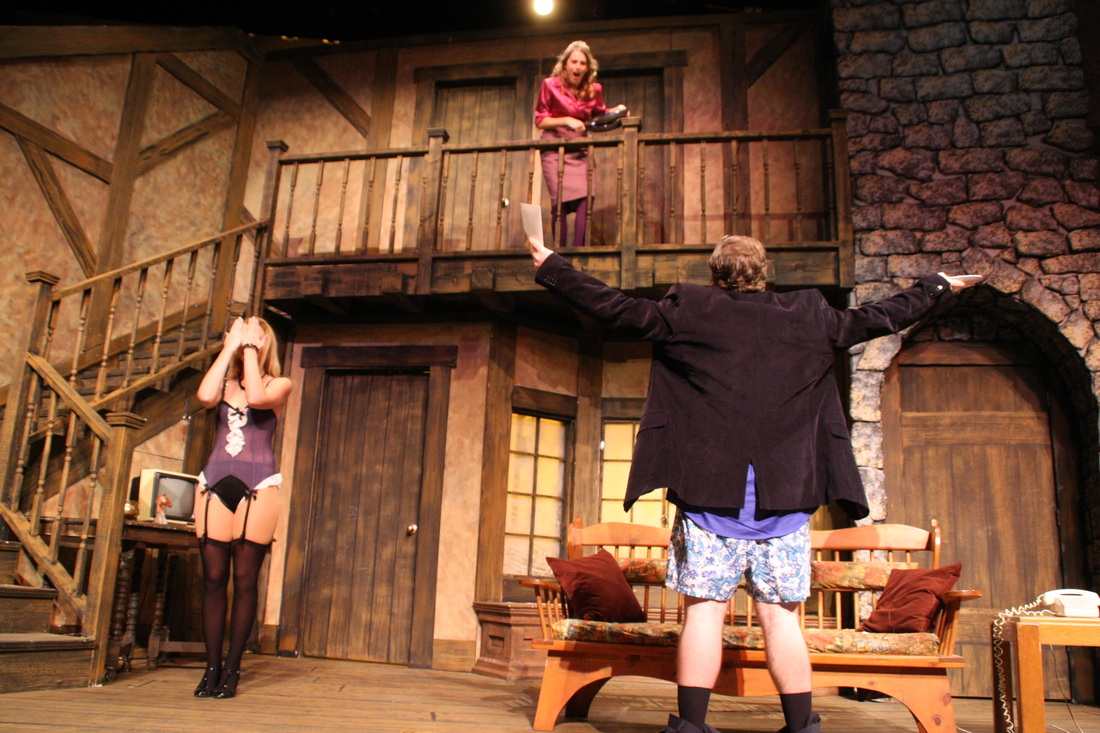
Noises Off


When I asked my theatre teacher about “Noises Off,” by Michael Frayn, he told me that it was essentially a “perfect play." I think he was right. Here’s why.

Noises Off is a farce. If you’re not entirely sure what a farce is, watch this short trailer for the show:


So, yeah. A lot of slapstick, a lot of low-brow humor. If you ask Google to define it for you, it’ll tell you that a farce is “a comic dramatic work using buffoonery and horseplay and typically including crude characterization and ludicrously improbable situations.” While not always especially sophisticated, farces can be very, very funny. The really cool thing about this farce, though, is that it’s a farce within a farce. The play is about a group of people rehearsing and performing a play called Night On. Act One shows their final dress rehearsal. They are not ready to open. In Act Two*, we see a performance--from backstage. The entire set is turned around. And Act Three (for which the set is turned back around) is the production’s disastrous closing night.

This set-up gives Michael Frayn a huge number of comic levels to play off of. For one, there’s the play they’re performing. It involves lots of mistaken identities, people running (or stumbling) around in their underwear, and several plates of sardines, whose disappearances and reappearances baffle the characters.

Add to that the situation the actors are in. There’s a lot of humor in the desperation of these poor people on the night before they open a show that they've only had two weeks to rehearse. One actor is drunk and also keeps wandering off, so that everyone has to go looking for him; one actress gets very distracted and keeps losing her contact lenses; the poor stage manager is repeatedly blamed for things that aren’t her fault; the director is getting fed up with everyone else because they keep having to stop; and so on and so forth,

Then you get to Act Two, which opens with the introduction of a few love triangles. Then the play starts, and no one backstage can make any sound. As things start (unsurprisingly) going wrong onstage, people backstage resort to some bizarre measures to try and fix them; actors coming on and off stage only get glimpses of what’s going on, and draw mistaken conclusions about what they see. Since no one can talk, no one can explain what’s actually going on, which leads to the perception of romantic relationships where there are none, and creates some very complex relationship dynamics. Jealous actors start seeking revenge on each other, creating intense conflicts backstage, some of which involve an axe.

And finally, in the last act, all hell breaks loose. After these people, who can no longer stand each other, have been working together for months on end, they’re barely holding it together. Even before the curtain goes up, it starts falling apart. Everything goes wrong, and while some actors try ardently to soldier through, others simply give up. The play tailspins before cataclysmically (and hilariously) crashing and burning, with disaster after disaster nonstop until the lights go down.

The reason that this play works so well is Frayn’s use of perspective. In the first act, we get a peek into the world of the actor, director, stage managers and technicians, and get to see what’s going on with them as well as what’s going on in the play they are trying to perform. In the second Act, we again get a glimpse into the secret world of the actor, but in a different context. In a literal sense, we see everything in reverse. Unlike the presumably confused fictional audience watching Night On, the real audience of Noises Off is aware of what’s going on onstage (the Night On stage, that is) and what’s going on backstage. We know why things are going wrong onstage and why the various people backstage are at each other's throats. We're the only ones who can see the full picture--it’s excellent dramatic irony. It works especially well because, having already seen what they’re trying to do, the audience isn’t distracted by the plot of the play-within-a-play and can focus on and understand what's happening to the struggling actors. In Act Three, as we watch the show fall apart, we see the play from the same perspective as the fictional audience, but with a wealth of background information about what’s going on. In a lot of ways, Act Three would be funny standing on it’s own; but it’s made much, much funnier by our knowledge of the relationships between the actors and what’s gone down between them.

That’s why it’s a “perfect play”--it’s constructed flawlessly. Each act build off the last, and the play gets funnier and funnier as it progresses until everything comes together perfectly at the end. It’s written cleanly and brilliantly. Time isn't wasted setting up jokes, because the jokes set each other up, often in ingenious ways. It’s not too complicated for the audience to follow it, but it’s complex enough to make them forget things momentarily and to keep them from predicting everything that’s going to happen, so the element of surprise is preserved. It’s visually stimulating (constant movement, lots of doors), extremely clever, plays off the longstanding British tradition of the farce, and is, above all, really fun.

I'd highly recommend going to see it. There are also lots of versions of it on youtube, but none of them can really compare to what it would be like live onstage. Reading it is cool, but definitely a challenge--without the help of visuals, it takes a lot of focus to keep track of everything that's going on, especially in Act Two. If you don't feel up for that, I'd recommend reading There Shall Be No Bottom: A Bad Play For Worse Actors, a short play by Mark O’Donnell. It’s similar to Act Three of Noises Off, but is much easier to follow, and takes probably about five minutes to read. It's no where near as good, but it will give you a feel for what Noises Off is like.

I hope this was interesting--thanks for reading.

--CMcC


*In the Script, Act Two and Act Three are also called “Act One,” because each act shows Act One of Night On, but for clarity’s sake I’m just going to call them acts Two and Three.